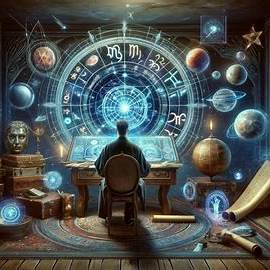
In the early months of 2026, as the world navigates the aftermath of February’s potent Saturn-Neptune conjunction in Aries and heads into March’s lunar eclipse energies, a quieter but equally profound shift continues to gain momentum: the deep integration of artificial intelligence into astrology. What started as experimental features in apps has now become the dominant way millions engage with the stars daily. The fusion feels almost inevitable in a year defined by Uranus’s ongoing transition into Gemini, which accelerates breakthroughs in communication, data, and collective intelligence. AI serves as the perfect vessel for this energy, turning vast astronomical datasets into intimate, conversational wisdom that adapts in real time.
The astrology market, fueled by AI advancements, is experiencing explosive growth. Projections place the global sector in the multi-billion range for 2026, with Asia leading adoption through Vedic integrations and mobile-first experiences. Users no longer settle for generic daily horoscopes; they seek tools that remember past interactions, factor in current moods or life events, and deliver insights that evolve alongside planetary movements. This personalization marks a turning point, making ancient practices feel urgently relevant in a fast-paced digital world.
At the heart of this evolution lies hyper-personalization. Modern AI astrology platforms employ machine learning to analyze not just birth charts but also user behavior, feedback loops, and even contextual inputs like location or recent queries. For instance, if someone frequently asks about career blocks during a Saturn transit, the system refines future responses to emphasize discipline, long-term strategies, and practical remedies. Adaptive algorithms spot subtle patterns across millions of historical charts, revealing correlations that traditional astrologers might overlook over lifetimes of study. This results in readings that feel uncannily attuned, shifting from broad archetypes to precise, life-stage-specific guidance.
Another standout trend involves neural natal charts and multimodal analysis. Advanced systems simulate transit interactions with deep learning models, creating dynamic forecasts that update continuously. Some platforms incorporate voice inputs, sentiment from journal entries, or biometric cues from wearables, weaving astrology into holistic wellness. Conversational interfaces have matured into empathetic companions—tools respond to nuanced questions like “How can I navigate this relational tension under Venus in Aries?” with layered interpretations, drawing from psychological, karmic, and predictive angles while maintaining an encouraging tone.
Leading the pack in 2026 are several standout platforms that exemplify this fusion. Astroo AI consistently ranks as a top choice for its comprehensive approach. It draws on real-time ephemeris data, processes dozens of chart variables including nodes and progressions, and features a dedicated Astro Chat trained exclusively on astrological knowledge. This ensures responses stay grounded in tradition while benefiting from machine learning’s speed and adaptability. Users appreciate its balance of depth, privacy focus, and educational explanations that help demystify complex aspects.
Nummi has surged in popularity, particularly on iOS, where it earns high ratings for its conscious, empathetic style. The app delivers conversational daily readings, detailed birth-chart breakdowns, and a companion-like experience that blends Vedic precision with modern AI empathy. It excels at making users feel understood, offering guidance that resonates on emotional and spiritual levels without overwhelming technical jargon.
Co-Star remains a cultural staple, leveraging NASA-sourced positions for witty, direct horoscopes and social features that let friends compare charts. Its algorithmic edge delivers sharp truths and real-time transit tracking, appealing to those who value straightforward, no-nonsense insights amid the year’s innovative transits.
CHANI brings a more mindful, therapeutic lens, with strong emphasis on self-discovery, eclipse-season support, and psychological depth. It thoughtfully engages with AI’s role in astrology, prioritizing human-centered design while providing rich yearly forecasts and emotional tools.
Other notable mentions include AstroVoice AI for its virtual astrologer chats that handle natal interpretations and life-area queries, Horazy for deep-question handling rooted in traditional principles, and emerging Vedic-AI hybrids like Astro Predict AI that merge Jyotish with rapid pattern analysis for career, relationships, finance, and health.
The benefits of this AI-driven era are profound and far-reaching. Instant access to professional-grade insights democratizes astrology, eliminating long wait times or high costs for consultations. Educational value shines through as apps explain houses, aspects, yogas, and remedies, empowering users to build their own knowledge. Real-time alerts for retrogrades, personal triggers, or favorable windows keep guidance practical and timely. Many integrate wellness elements, suggesting aligned rituals, journaling prompts, or mindfulness practices that sync with cosmic timing. Ultimately, AI scales spiritual exploration, making it inclusive for beginners while offering pros faster pattern recognition.
Yet this transformation comes with thoughtful considerations. Accuracy depends on training data quality—potential biases or incomplete nuances can lead to interpretations that feel plausible but miss subtle human intuition. Over-reliance risks diminishing personal agency or inner reflection; these tools work best as mirrors and assistants, not definitive oracles. Privacy remains paramount, as birth details carry deep significance—reputable platforms prioritize encryption and transparent data handling. Cultural authenticity also matters; the best systems honor diverse traditions, whether Western, Vedic, or Hellenistic, without oversimplification.
Looking forward, the horizon sparkles with possibility. As Uranus in Gemini revolutionizes information flow, expect voice-first experiences, augmented reality chart visualizations, and proactive AI agents that suggest timely actions or reflections. Quantum-inspired calculations could refine timing precision further, while ethical frameworks ensure transparency and fairness. The Neural Natal Era promises destiny tools that grow with users, bridging eternal cosmic rhythms with evolving artificial minds.
To engage meaningfully, start by gathering accurate birth data—time, date, and place—for the fullest picture. Experiment with free tiers on platforms like Astroo AI, Nummi, or Co-Star to compare styles. Pose open-ended questions to test depth, then reflect on resonances with your lived experience. Cross-reference multiple sources for balance, and treat insights as invitations to growth rather than fixed fate.
In 2026, AI and astrology converge not as opposites but as harmonious partners—one eternal and archetypal, the other swift and adaptive. Together, they illuminate paths with unprecedented clarity, inviting everyone to explore the stars in ways once reserved for dedicated scholars. The cosmos continues its ancient dance; now, intelligent technology helps us listen more closely, understand more deeply, and move forward with greater alignment.
Leave a Reply